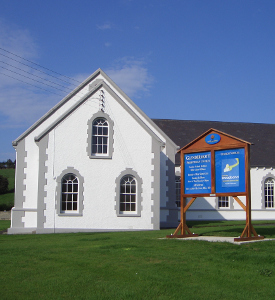
CLONDERMOT, which is the name of a townland as well as a whole parish, is derived from the name of the clan who ruled there, the CLAN DIARMADA or the clan of Dermot. This clan was a Sept of the CENEL EOGHAIN on the East of the River Foyle. The Clan Diarmada were the O’Carolans whose chief was O’Cairellain.

The O’Donnells drove the O’Carolans out of the Magh-Ithe on the West side of the River Foyle and they evidently established themselves on the East side of the river. The Parish passed to the Bishop of Derry during the Wars of Shane O’Neil.

The country from the Foyle to the Bann was sometimes called ‘Patria de O’Kane.’ The chief residence of the O’Kanes was in their castle situated on an island in the East lough of two Enagh Loughs. The Barony of Armagh was called after this Castle of Enagh. This Barony was one of the eight baronies which comprised the County of Tyrone, which then included the County of Londonderry.

The Barony of Armagh was changed into Tirkeeran about 1639, and comprised the Parishes of Cumber, Clondermot and Faughanvale (or Muff). So the Parish of Glendermott is part of the Barony of Tirkeeran. It measures approximately nine miles by five miles, and has 173 acres of water. There are over 21,514 acres in the parish of which 4,410 acres is bog, mountain etc.

Evidently the Parish had little to offer. There were some natural resources such as rock to quarry. There were also deposits of sand and gravel that had been left as a result of the Ice Age, when movements of huge fields of ice from Donegal and even as far away as Scotland, carved out our landscape. Other natural resources were woodlands of oak and birch, water-power and of course the fertile soil where settlers could eke out a living.

St Patrick is said to have founded a church in Ardkill and St Columbkille founded a monastery in the Parish. Ailid O’Dermit founded a nunnery at Rossnagalliagh in 879.

Land in Ireland was divided up into large areas called baronies, parishes or electoral wards. Each of these larger units was divided into townlands. There are 77 townlands in the Parish of Glendermott. Each townland was given a name relating to some characteristic such as height or hill, trees, vegetation, lakes, fortifications or even relating to the clan or family name associated with the area.

Many townlands in Ireland begin with ‘bally’ derived from the Irish word baile (town or townland). Other prevalent Irish names which feature in our Parish are: drum or droin = ridge, alt = height, ard = high, coil or killy = wood or vegetation, lis and dun = fort, gort = field, carry = moor, more = great.

The following is a list of all the townlands in the Parish of Glendermott and the meanings of their names.

Name of Townland – / – Meaning

ALTNAGELVIN

The height or glen of the sparrows OR the glen of the white ben, peak or gable.
GOLDSMITHS LANDS

ARDKILL (correct name should be ARDKILLY)

The high wood. There is a tradition that St Patrick founded a church here.
CHURCH LANDS

ARDLOUGH

The high lake, or the hill of the lake, or the hill of the dark, or the dark hill.
CHURCH LANDS

ARDMORE

The great height or hill.
GROCERS LANDS

ARDNABROCKY

The height, or hill of the badgers, or fox cover, or the hill of the speckled or rough tummocky ground.
GOLDSMITHS LANDS

AVISH

The coarse mountain pasture (a mountain valley).
GOLDSMITHS LANDS

BALLYOAN

The town of the river, or Owen’s town.
CHURCH LANDS

BALLYORE

The townland of the gold or the town of pride or the grey town.
GOLDSMITHS LANDS

BALLYSHASKY

The town land of the sedge grass (or dried swamp).
GROCERS LANDS

BOGAGH

The bog.
GOLDSMITHS LANDS

BOLIES

The summer mountain dairies.
GOLDSMITHS LANDS

BRICKKILNS

The speckled kilns.
GOLDSMITHS LANDS

CARN

The cairn or heap of stones or tomb.
CHURCH LANDS

CARNAFARN

The cairn of the alder trees or the hill or the quarter of, the alders.
GOLDSMITHS LANDS

CARRAKEEL

The narrow weirs.
GROCERS LANDS

CAW

The battle (the site of battle) or the bend of the river or the quagmire or the house.
CHURCH LANDS

CLAMPERNOW

The new controversy or the controversy knowe (or hill).
GOLDSMITHS LANDS

CLONDERMOTT

The district of the Clan Diarmata or O’Carolans.
CHURCH LANDS

CLOONEY

The meadows.
CHURCH LANDS

COOLKEERAGH

The hill back of the sheep.
GROCERS LANDS

CORRODY

The hill of the red (iron scum) or the common field.
GOLDSMITHS LANDS

CRAIGTOWN

Rock town.
GOLDSMITHS LANDS

CREEVEDONNELL

The town of the branch of the O’Donnells or Donnell’s wide branching tree.
GOLDSMITHS LANDS

CROMKILL

The sloping wood or bending hazels or the woods of the wild garlic.
CHURCH LANDS

CURRYFREE

The moor of the heath or the moor of the moor-fowl or grouse.
GOLDSMITHS LANDS

CURRYNIERIN

The moor of the iron.
GROCERS LANDS

DISERTOWEN

Owen’s hermitage or the hermitage of the river.
GOLDSMITHS LANDS

DRUMAGORE

The ridge of the goats.
GOLDSMITHS LANDS

DRUMAHOE

The ridge of the cave or grave or the cup-shaped hollow or river or mist.
GOLDSMITHS LANDS

DRUMCONAN (OR DRUMCORN)

The ridge of Conan – Conan was a contemporary of Finn McCool.
GOLDSMITHS LANDS

DUNHUGH

Hugh’s fort.
GOLDSMITHS LANDS

EDENREAGH BEG & EDENREAGH MORE

The grey hill brow.
GROCERS LANDS

ENAGH

The marsh.
CHURCH LANDS

FINCAIRN

The white cairn or heap of stones or white tomb.
GOLDSMITHS LANDS

GLENDEROWEN

The glen between the two rivers (Foyle and Burngibba (or between the present and former course of the Foyle) or the glen of Owen’s oak wood.
GOLDSMITHS LANDS

GLENKEEN

The beautiful glen or distant glen.
GROCERS LANDS

GOBNASCALE

The land point of the stories – (probably the residence of a professional story-teller) or the point of the shadow.
GOLDSMITHS LANDS

GORTGRANAGH

The field of the grain or the granary field or the gravelly field.
GROCERS LANDS

GORTICA

The field of the battle or the field of the stirk.
GOLDSMITHS LANDS

GORTICROSS

The field of the cross.
GROCERS LANDS

GORTIN

The little tilled field.
GOLDSMITHS LANDS

GORTINURE

The field of the yew tree.
GOLDSMITHS LANDS

GORTNESSY

The tilled field of the waterfalls or the field of the weasels.
GROCERS LANDS

GORTREE

The field of the gallows or the field of the reproof or the King’s field.
GOLDSMITHS LANDS

GRANSHA & GRANSHA INTAKE

The grange or farm for grain.
CHURCH LANDS

GREERSTOWN (OR CLOGHORE)

The stone of gold or the great stone or the pale grey stone.
GOLDSMITHS LANDS

KILFINNAN (OR KILFENNAN)

St Finan’s Church. St Finan was surnamed LOBHAR – the leper. He died between 675 & 695.
CHURCH LANDS

KILLYMALLAGHT

The wood of the curses.
GOLDSMITHS LANDS

KITTYBANE

The white woods or the white hillock or the sloping hill.
GOLDSMITHS LANDS

KNOCKBRACK

The speckled hill.
GROCERS LANDS

LISAGHMORE (OR THE TRENCH)

The great fort or the fort of the great ford –(could have been a large swamp at one time).
GOLDSMITHS LANDS

LISDILLON

The fort of the Dillons or the fort of the flood.
GROCERS LANDS

LISGLASS

The green fort.
GROCERS LANDS

LISMACAROL

McCarroll’s Fort.
GOLDSMITHS LANDS

LISNAGELVIN

The fort of the sparrows.
CHURCH LANDS

LISNEAL

The fort of the limestones or Neill’s fort.
CHURCH LANDS

LISSAHAWLEY (LISAHALLY)

Awley’s fort or the fort of the Port or the fort of the ford of the sea.
CHURCH LANDS

MAGHERACANON

The plain of the Canons or the plain of the cannon or the plain of the white-faced hills.
GOLDSMITHS LANDS

MANAGH BEG ( OR MANAGHMORE)

The townland of the monks or the plain of the horses.
GROCERS LANDS

MAYDOWN

The plain of the fort.
GROCERS LANDS

PREHEN

The place of the crows.
GOLDSMITHS LANDS

PRIMITY

The townland of the old tree roots.
GOLDSMITHS LANDS

ROSSNAGALLIAGH

The wood of the nuns.
CHURCH LANDS

STRADREAGH BEG & STRADREAGH MORE

The grey street or the street or village of the gallows.
CHURCH LANDS

TAGHARINA

The house of the Queen.
GOLDSMITHS LANDS

TAMNEYMORE

The great field. Here in 1624 the O’Kane shot Mr Skipton who had gone into possession of some of O’Kanes lands at Beechill in Ballyshasky.
GOLDSMITHS LANDS

TEMPLETOWN

The town of the church.
CHURCH LANDS

TIRBRACKEN

The land of BRECAN or the district of the speckled patches of land. St Brecan was the Patron Saint of Clooney Church and was believed to have been born in Dungiven.
GROCERS LANDS

TIRKEEVENY

The district of O’Keeveny or O’Kavanagh.
GOLDSMITHS LANDS

TULLY (UPPER & LOWER)

The hillock.
GOLDSMITHS LANDS

TULLALLY (UPPER & LOWER)

The hillock of the cliff or the hillock of beauty.
GROCERS LANDS

WARBLESHINNEY

The tail of the fox or the mountain of the fair-haired woman.
GOLDSMITHS LANDS

map

Tags: , ,

Comments are closed.